
4 live Zoom sessions in a small group
What if there was a choice between ‘that set me off’ and how you react?
Learn a practical process that helps you regain clarity under pressure and decide what to do next.
€125
“I used your SOS technique in a situation that was so important and decisive for me – and I didn’t just make the most of it, I got something I never would have even hoped for!
I honestly feel as if I’ve been given a superpower: even in such a short moment, under enormous pressure, I was able to make a completely considered decision.”
— Ivana Stanojević

Led by Mara
Lawyer and NLP Trainer (IANLP)
Starts
26 November
When
Thursdays, 17:30 CET
Group
Max. 12 participants
Guarantee
7-day money-back
Does this sound familiar?
You feel like you’re always putting out fires.
Work. People. Deadlines. Kids. School. Home. Commitments. And often several of them at once.
Someone’s running late or hasn’t done what they were supposed to. The plan has changed. Another problem has landed on your plate. You need to have an awkward conversation at work — you want to say what you think clearly and constructively, but you can already feel the tension building.
You rely on other people to keep things running, but you can’t control whether they’ll read the situation correctly, give you all the information or turn up on time. At home, another set of responsibilities is waiting — the kids, their activities and moods, the house, your partner, organising everyday life.
And sometimes all it takes is one more small thing. Traffic. Nowhere to park. One more call. One more change of plan.
And then you react.
Maybe you say something too quickly.
Maybe you get defensive and over-explain.
Maybe you freeze completely.
Or maybe two hours later you think: ‘That’s what I should have said.’
The problem isn’t that you feel stress, anger, fear or frustration.
Being composed doesn’t mean you stop feeling emotions. It means your first emotion doesn’t get the final say.
What if there was another option?
Imagine recognising the moment you feel the pressure rising.
Not after the conversation. While it’s happening.
You pause. You notice what’s going on in your body, your thoughts and your emotions. You separate what actually happened from everything your mind is adding in that moment.
And instead of letting your first reaction take over, you create enough space to decide: What do I want to do now?
That doesn’t mean you’ll always agree. It doesn’t mean you’ll stay quiet. It doesn’t mean you won’t be angry. It just means your first impulsive reaction no longer has to act on your behalf.
You can say no.
You can disagree.
You can ask for what you need.
You can set a boundary.
The goal isn’t a life without pressure.
The goal is for pressure not to choose your reaction for you.
My story
I know what it’s like when your first reaction wins.
Early in my career, I worked incredibly hard. I was ambitious and conscientious, and I wanted to get everything right. But I wasn’t very good at saying ‘no’. Over time, I became seriously overloaded.
Then I made a small mistake. It had no real consequences, but I was called in for a talk. As I listened to the criticism, I could feel the anger building. I thought about everything I do, how hard I try, how much I give — and how unfair it was to be lectured over one small thing.
When I was told that a mistake like that wasn’t expected of me and that perhaps I needed a break or a change, I replied:
‘Fine. What’s my notice period?’
I didn’t walk into that meeting planning to resign. But my reaction was faster than I was. Only later did I realise what I’d actually done.
And that’s exactly one of the things we work on in this programme. What happens between:
Trigger
Emotion
Reaction
Consequence
And how we can bring into that process something that’s often missing under pressure: choice.
Introducing
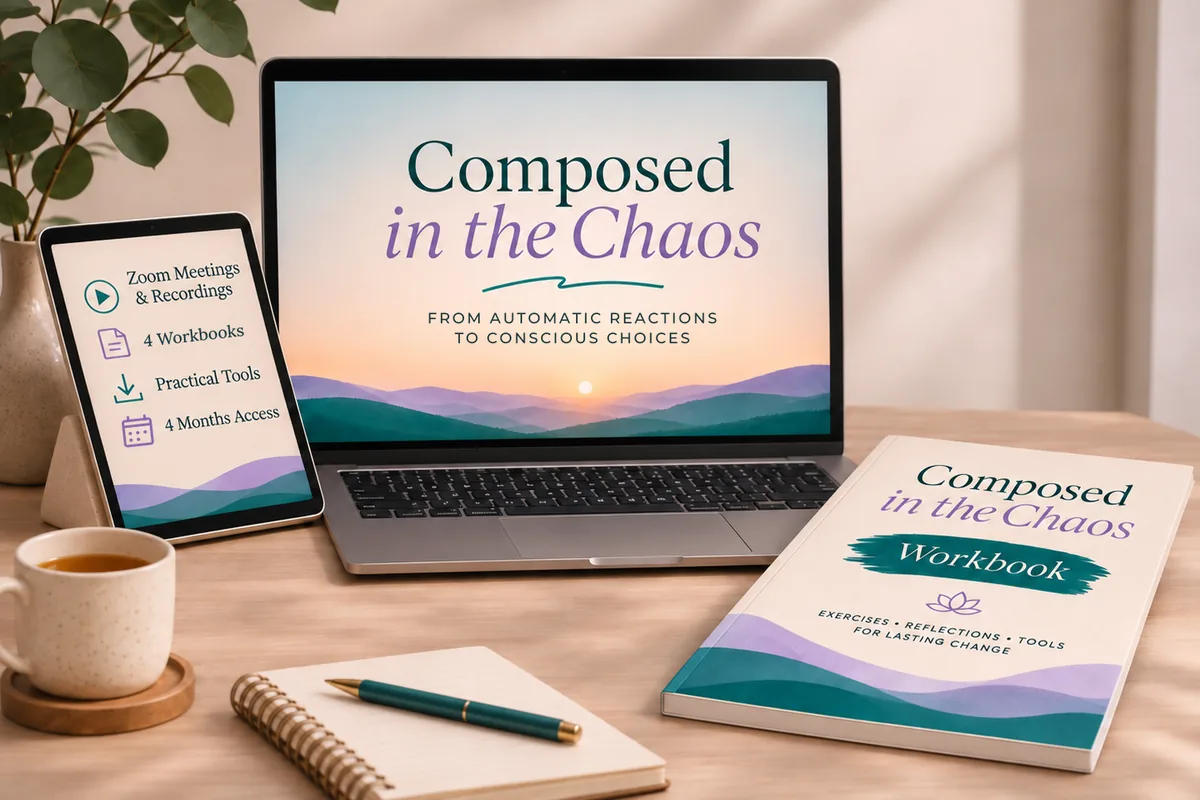
Composed in the Chaos
From Automatic Reactions to Conscious Choices
A practical programme of 4 live Zoom sessions in a small group. You won’t learn how to ‘stop feeling’. And I won’t tell you that you just need to ‘calm down’. You’ll learn a process you can use when the pressure really hits:
Notice
what’s happening.
Interrupt
the automatic reaction.
Regulate
your state.
Regain
perspective.
Understand
what’s going on.
Choose
your response.
We don’t stop at theory.
We’ll work with real situations and practise responses you can use in everyday life.
We don’t teach passivity.
Being composed doesn’t mean letting others do whatever they want. You’ll learn how to stay calmer while still saying ‘no’, disagreeing or clearly asking for what you need.
We work in a small group.
I want there to be room for practice, questions and working through situations that matter to the people taking part.
The programme
What we’ll work on together
Four modules, step by step — each with exercises and a workbook.
Pause before you react
Recognise the moment before your reaction takes over.
What we cover in this module
You’ll learn to recognise your stress signals — in your body, thoughts, emotions and behaviour — and create a pause between the trigger and your reaction.
We’ll work on:
recognising your natural reaction, your personal triggers, early signs that stress is building, simple regulation techniques and the SOS process:
Stop → Observe yourself and your breathing → Survey the situation → Act
After this module: you’ll be able to notice sooner when stress is taking over and interrupt your automatic reaction before it decides for you.
Your thoughts aren’t facts
Regain perspective when your mind starts imagining the worst.
What we cover in this module
Not all pressure comes from what actually happened. Some of it comes from what we tell ourselves about it.
You’ll learn to tell facts from interpretations, recognise catastrophising and bring your focus back to what’s within your control.
We’ll work with questions such as:
What actually happened? · What am I adding to it? · How likely is the worst-case scenario, really? · If it does happen — what will I do? · What’s one useful thing I can do right now?
After this module: you’ll have a process for stopping the mental spiral and moving from endless overthinking to useful action.
Stay calm even when the other person isn’t
Stay composed — and notice what’s really going on for the other person.
What we cover in this module
In a difficult conversation, regulating yourself isn’t enough. Once you manage not to react on autopilot, you have room to pay attention to the person in front of you: what they’re feeling, what they need in that moment and what might be behind their anger, attack, withdrawal or frustration.
Through active listening, observation, open questions and reflecting back, you’ll learn to read the other person’s emotional state and needs more accurately — and adapt how you approach the conversation. Because what helps someone who is angry may not help someone who is scared, confused or feels misunderstood.
Stop → Regulate yourself → Listen → Understand → Respond
First, you regulate yourself. Then you listen and observe. You try to understand what’s happening for the other person. And only then do you choose how to respond. That doesn’t mean you have to agree with them or give them what they’re asking for. It means you don’t ignore their emotions and needs while you try to solve the problem.
We’ll work on active listening, open questions, reflecting back, tone, pace, silence, rapport, finding a shared goal and approaching the conversation in a way that fits what’s happening in that moment.
After this module: you’ll be able to stay more present in difficult conversations, recognise the other person’s emotional state and needs, and choose more consciously how to approach them — instead of automatically freezing, attacking, getting defensive or over-explaining.
Say what you want without losing control
Calm doesn’t mean passive.
What we cover in this module
You can understand the other person and still disagree. You can say no. You can set a boundary. You can ask for what you need.
Regulate yourself → Understand the other side → Communicate what you need
Using real situations, we’ll practise communicating clearly under pressure — then we’ll turn up the pressure and try again.
After this module: you’ll have a more concrete way to protect your boundaries, express disagreement and say what needs to be said — without unnecessary escalation.
What you get
A complete programme, materials and small-group work
When you sign up for Composed in the Chaos, you don’t just get 4 lectures. You get a practical programme, materials and support to help you start applying what you learn in real situations.
4 live Zoom sessions
Four sessions where we learn, do practical exercises and apply the process to real situations.
€160
Small-group work and support
This isn’t a course you buy, watch a few videos from and forget about. A maximum of 12 participants — room for questions, hands-on work and practice.
€50
4 practical workbooks
One for each module, so you can connect what we cover to your own triggers, thoughts, reactions and real-life situations.
€30
SOS cheat sheet
The whole core process on a single page — so when you need it, you don’t have to wonder, ‘Wait, what did we learn again?’
€20
Recordings of all 4 sessions
In case you want to revisit a particular part or can’t make one of the sessions. Available for 4 months.
€20
Total value
€280
Composed in the Chaos
€125
Card (Visa, Mastercard, Maestro, Discover) or PayPal
7 days to make sure it’s right for you. I want you to join with peace of mind. Come to the first live session and get a feel for how we work. If you decide the programme isn’t the right fit, you have 7 days after the first session to request a refund at mara@maramondo.com.
What do participants say?
What changes when you start applying what you’ve learnt?
Knowing what you should do when you’re under pressure isn’t enough.
The real value comes when you start using what you’ve learnt in real situations.
Here’s what participants in my workshops say.
“I’m much more aware of the moment in every conversation.”
“I’m much more aware of the moment in every conversation, I listen more actively and I try to apply what I’ve learnt.”
“Quite simply – it helps me handle difficult conversations and ‘difficult people’, and get to know myself even better in the process.”
— Petar Mijatović
“I’ve learnt to separate facts from my own assumptions better.”
“These techniques really help me stay calmer and more composed in lots of situations, and not waste energy on things that aren’t under my control.”
“Everything we talked about can be applied straight away – you just need to use it and practise it as often as possible.”
— Milenko C.
“I realised how often, instead of really listening, I’m already working out my reply.”
“Exercises like ‘just listen’, picking up on the word that matters to the other person and pausing for three seconds before answering sound simple, but in practice they change the whole conversation.”
“People open up more than you’d expect, and I react more calmly and thoughtfully.”
— Matej Križnjak
Being composed doesn’t mean you stop feeling emotions. It means your first emotion doesn’t get the final say.

Who leads the programme?
Hi, I’m Mara.
Corporate lawyer
NLP Trainer (IANLP)
Belgrade → Zagreb
Seven years ago, I moved from Belgrade to Zagreb. That period brought a lot of big changes and challenges in a relatively short time — and gave me a very personal experience of what it’s like to keep functioning when so much around you is changing at once.
Professionally, law taught me the value of the right word at the right moment. But the part that happens in your head and your stomach — before a difficult conversation, an important decision or when the pressure builds — isn’t something you learn at university.
So I kept learning. Through NLP, communication, stress management, coaching and leadership — but also through working with people and real situations where theory simply isn’t enough. I especially enjoy running workshops on communication and soft skills, and on understanding and managing yourself.
Staying composed under pressure isn’t just a trait you either have or don’t.
It’s a set of skills. And they can be learned.
I don’t believe the goal is to become people who never get angry, scared, overwhelmed or thrown off balance. I know myself what it’s like when your first reaction is faster than you are.
That’s why Composed in the Chaos was designed as a practical programme. Not to learn even more theory about stress, but to have a process you can use when the pressure really hits. To pause. Notice what’s happening. Regain clarity. And choose what you want to do next.
What do people say about the way I work?
“The workshop was brilliant – you made everything really interesting and you explain things so well.”
— M. C.
FAQ
Got a question?
What if I freeze completely under pressure?
That’s exactly one of the reactions we work with. Not everyone reacts to stress by getting loud or impulsive. Freezing — when you’re lost for words or simply shut down — is part of the programme too.
What if I’m just a hot-tempered person?
The aim of the programme isn’t to change your personality or get rid of your emotions. We’ll work on recognising your reaction earlier and creating space between what you feel and what you decide to do.
Is this only for women?
No. The programme is for anyone who deals with pressure, responsibility and challenging conversations — whether you run your own business, work for a company or juggle professional and personal responsibilities.
What if I can’t make one of the Zoom sessions?
You’ll get recordings of all four sessions, available for four months.
How much time do I need between sessions?
Alongside the live sessions, you’ll get practical exercises and workbooks. The idea isn’t to add another huge commitment to your schedule, but to start noticing and applying what we cover in everyday situations.
Do I have to talk about personal situations in front of the group?
You don’t have to share anything you don’t want to. Working in a small group allows for practical work and exchange, but you decide how much you share.
How many people will be in the group?
The programme is deliberately run in a small group so there’s room for hands-on work. A maximum of 12 participants.
I already know quite a lot about stress and communication. Will I learn anything new?
This programme isn’t designed simply to pass on information. The focus is on the process and on practice: what you do when you’re actually under pressure, when the other person isn’t calm, or when you know the theory — but can’t access it in that moment.
My biggest problem is that I can’t say no. Do we cover that?
Yes. In the fourth module, we work on clear communication, disagreeing, setting boundaries, asking for what you need and saying ‘no’ without unnecessary escalation.
How does the guarantee work?
You have 7 days after the first live session to request a refund by emailing mara@maramondo.com. The amount will be refunded to the account you paid from.
When do we start?
26 November. The programme consists of 4 live Zoom sessions over one month, on Thursdays at 17:30 CET.
The next stressful situation will come.
We can’t control when. We can’t always control other people either — their decisions, moods, mistakes or reactions. But we can work on what happens between the trigger and our response.
Composed in the Chaos is a practical programme of 4 live sessions for people who want to notice their automatic reaction sooner, regain clarity and choose more consciously what to do next.
Not so you stop feeling. Not so you’re always calm. But so that your first reaction doesn’t have to get the final say.
4 live Zoom sessions + recordings + 4 workbooks + SOS cheat sheet + small-group work
€125
4 live Zoom sessions